Why your website isn't getting enquiries (and it's probably not what you think)
You've been tweaking things. Moving sections around. Changing the hero image, updating the copy, trying a new button colour. You've asked a friend for feedback. You've read the articles. Maybe you've even done a course.
And still - the enquiries aren't coming.
So you land on the obvious conclusion: the website needs a redesign. A fresh look. Something more polished, more modern, more you.
Here's the thing. That's almost never the actual problem.
After working with dozens of established service-based business owners, the same pattern keeps showing up. The website looks fine. Some of them look genuinely good. But they're still not working - and the reason has almost nothing to do with how they look.
The problem is almost always strategy. Or the absence of it.
The thing most founders think the problem is (and why they're wrong)
When enquiries dry up, most business owners look at design first. The colours feel dated. The photos aren't great. The layout doesn't feel right anymore.
So they do what makes sense: they fix the thing they can see.
A new colour palette. A rebrand. A fresher look. Sometimes a completely new website.
And then three months later, nothing much has changed. Because the design was never what was broken.
Design is the most visible part of a website - which is exactly why it gets the blame. But a beautiful website with no strategic foundation is just expensive decoration. It looks better. It still doesn't convert.
Most websites aren't broken because they're ugly. They're broken because there's no strategy behind them.
The actual reason your website isn't converting
A website that isn't generating enquiries has almost always lost - or never had - one thing: clarity.
Not just in the copy. Clarity across the whole experience, from the moment someone lands on your page to the moment they decide whether to reach out.
When a website is unclear, visitors don't always bounce immediately. Sometimes they stay. They read around. They click a few things. And then they leave, quietly, without reaching out - because somewhere along the way they lost the thread. They weren't sure if you were the right fit. They couldn't quite tell what you actually do. They didn't know what to do next.
You'll never know this happened. Your analytics just shows a number.
That's why clarity is so much harder to diagnose than design. You can see when something looks off. You can't always see when something reads off.
Pretty doesn't sell. Clarity does.
The 4 places clarity breaks down on a website
This is where most websites lose people - and most of them happen before a potential client ever reaches your services page.
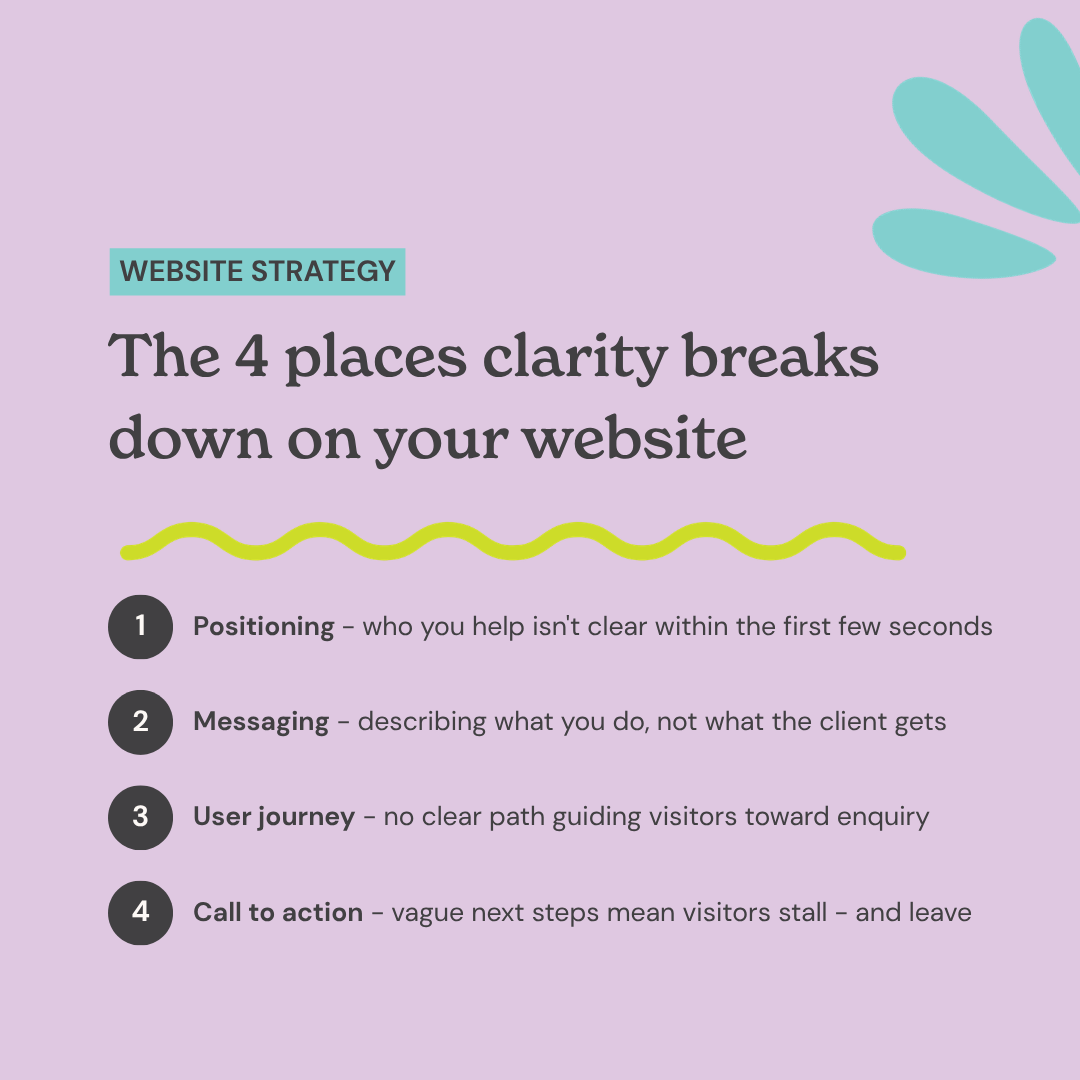
1. Positioning
If a visitor can't tell within a few seconds who you help and what problem you solve, you've already lost them. Vague positioning is one of the most common issues I see — especially on homepages that try to speak to everyone, and end up connecting with no one.
2. Messaging
Your copy might be describing what you do without explaining what your client gets. There's a real difference between "I design Squarespace websites" and "I help established founders build a website that reflects the business they've actually built." One is a feature. The other is a reason to reach out.
3. User journey
Where does someone go after the homepage? Is there a clear path guiding them toward enquiry? Or do they have to figure it out themselves? Most websites are designed like a brochure - you look at it, and then you're done. A strategic website has a flow that moves people from interest to action, without them having to work for it.
4. The call to action
If your call to action is vague - "get in touch", "let's chat", "learn more" - your conversion rate will reflect that. The goal isn't to pressure people. It's to make the next step feel obvious and low-friction. When that's missing, visitors stall. And stalling usually means leaving.
Any one of these can quietly kill your enquiry rate. When two or three are off at the same time, it can feel like the whole website isn't working - even if it looks great.
What to look for before you blame the design
Before you invest in a redesign, it's worth running a quick check on these four areas first.
Start with your homepage. Read it from the perspective of someone who's never heard of you. Within the first few seconds: can they tell who you help? What problem you solve? Why you, specifically?
Then follow the path. If someone wanted to work with you, how obvious is the next step? Are your services clearly explained? Is there a single, clear call to action guiding them forward?
Finally, check your copy - not for polish, but for specificity. Does it speak directly to the situation your ideal client is actually in? Or is it describing your process more than their problem?
This isn't a full audit. But if something jumps out in that quick scan, you've found a starting point - and it probably has nothing to do with your font choice.

The shortest path back to enquiries
Here's the honest answer: most business owners aren't well-placed to audit their own website objectively. It's too close. You know what you meant to say, which makes it hard to see what someone else actually reads.
That's exactly why the first step I recommend isn't a redesign. It's a diagnosis.
A proper diagnosis looks at your website the way a potential client does - with fresh eyes and no context. It identifies where clarity is breaking down, what's working, what isn't, and what to prioritise. Not a surface-level checklist. A strategic review of how the website is actually functioning as a business tool.
From there, you know what you're fixing and why. Sometimes that means a targeted copy update. Sometimes it means a structural change. Occasionally it does mean a full rebuild - but with a clear brief, not just a vague feeling that something needs to change.
Most websites don't need to be prettier. They need to be clearer.
If you're not sure where yours is losing people, a Website Diagnosis is the place to start. In 7 days, you'll have a video walkthrough and written report that tells you exactly what's not working - and what to do about it.